
The PISCO programme (PIedmont Space COmponents), financed by the Piedmont Region, brought together several of SMLab's space-component activities — from cryogenic sensing to large-format metal additive manufacturing.
Cryogenic wireless sensors for turbopumps
Within PISCO, SMLab took part in the realization of cryogenic, wireless, self-powered sensors for the turbopumps of space liquid-propulsion stages — the foundational experience from which the later next-generation launcher-avionics activities were developed. The goal was to overcome the installation complexity of traditional wired instrumentation by bringing the sensor — electronics plus transducer — right onto the body of the turbopump, integrating the transduction element into a single, self-contained package.
- Cryogenic-capable electronics: a sensor node engineered to keep operating in extreme hot/cold conditions and to detect pressure, temperature and vibration in turbopump areas exposed to cryogenic temperatures and very high pressures.
- Wireless, cable-free node: no electrical connections to the outside — the transducer sits directly on the surface to be monitored, removing wiring and improving measurement quality.
- Self-powered operation: each node manages and generates its own energy for the transducers, being fully autonomous.
- Compact, sealed package: a single container combining thermal protection, mechanical/structural installation and the sealing of the cryogenic fluid flows that could escape from the monitoring ducts.
The concept was matured through prototypes validated on a preliminary turbopump test bench, establishing the wireless cryogenic-sensor technology base that SMLab subsequently applied to next-generation launcher programmes.
Large-format additive manufacturing of propellant tanks
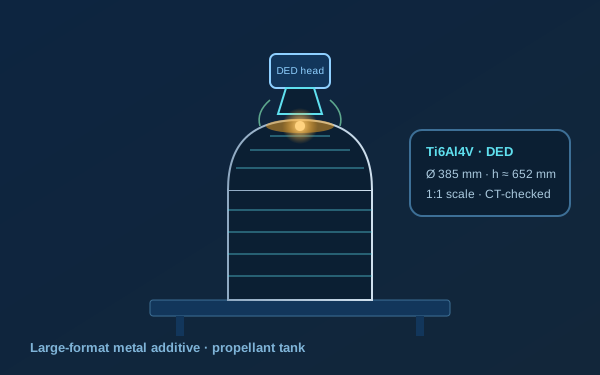
Still within the space-components theme, SMLab conducted an applied-research activity on the manufacture of a space propellant tank by metal additive manufacturing — specifically Direct Energy Deposition (DED) — as an alternative to traditional processes based on machining from castings. The tank (a hydrogen-peroxide container) was produced at 1:1 real scale — 385 mm in diameter and about 652 mm in total height — as two joined half-shells, based on an industrial study design.
- Material: Ti6Al4V titanium alloy, chosen for its high specific strength and excellent corrosion resistance; being a reactive material, deposition required a dedicated gas-shielding unit mounted on the nozzle.
- Build features: printing of the individual features — hollow base cylinder, hemispherical shell and cylindrical wall — with tuned tool-paths and process parameters.
- Quality characterization: full assessment by computed tomography (CT) and multi-scan, verifying the geometric accuracy of the shells and the internal quality of the deposition.
The activity demonstrated the feasibility of realizing large-format metal structures for space through additive manufacturing, while identifying the process-control aspects (fusion, penetration and layer overlap) that are critical for this class of components — a direct expression of SMLab's additive-manufacturing roots.