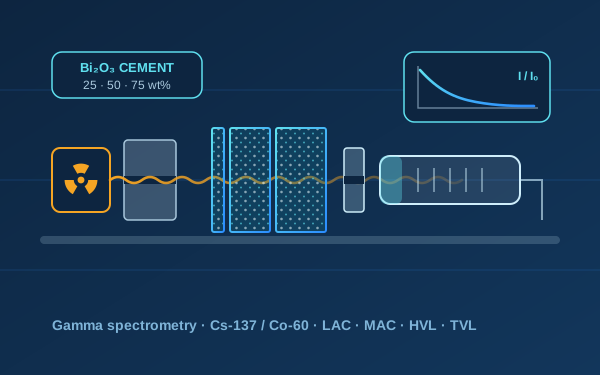
This research explored bismuth oxide (Bi₂O₃) nanoparticles as a lightweight aggregate in cement paste to absorb ionizing radiation: a non-toxic alternative to lead for shielding against X- and gamma rays. It is the experimental foundation of SMLab's Nuclear & Radiation Protection area.
The activity was carried out between 2017 and 2019 by a member of SMLab's shielding expert group, in the laboratories of the DISEG and DISAT departments of the Politecnico di Torino, and was assessed as a meritorious thesis.
Materials and samples
Four series of cement-paste samples were prepared, with 0, 25, 50 and 75% Bi₂O₃ by weight of cement; the series without additive served as the reference. Samples were cast in 10, 40 and 50 mm thicknesses, so they could be recombined into multilayer configurations of different total thickness. Mechanical tests were also performed according to the applicable standards.
Gamma spectrometry bench
Attenuation was measured by gamma spectrometry with two calibrated, practically monoenergetic sources, ¹³⁷Cs and ⁶⁰Co, keeping the source–photomultiplier distance fixed. The targets were placed in the free space between source and detector, which takes up to 100 mm of material.
- Two purpose-designed cylindrical collimators, both 50 mm in diameter: an aluminium one (20 mm thick, 8 mm bore) and a lead one (67 mm thick, approx. 6 mm bore).
- Collimation and careful alignment narrow the beam and limit build-up effects, which matter when several samples are stacked into a multilayer target.
- The same measurement procedure was applied to every sample set, so the results are directly comparable.
Analysis and results
From the measurements, the group calculated the linear (LAC) and mass (MAC) attenuation coefficients and the half- and tenth-value layers (HVL, TVL). These were compared with the values computed by NIST XCOM for the actual cement composition at each Bi₂O₃ loading.
The work was presented at two international conferences in 2018 and published in a peer-reviewed journal:
- Design of bismuth oxide nanoparticles as lightweight aggregate in cement composites against X-rays. Material Design & Processing Communications, 1(2), e34, 2019.
- Cementitious Composites Based on Bismuth Oxide Nanoparticles for X-ray Shielding — WCCM XIII / PANACM II, 13th World Congress on Computational Mechanics, New York, July 2018.
- Cement Composites with Bismuth Oxide Nanoparticles for X-ray Shielding — NICOM6, 6th International Symposium on Nanotechnology in Construction, Hong Kong Science Park, December 2018.
Outlook
These measurements are the starting point for two of SMLab's development lines: lead-free, 3D-printable nanostructured shielding for radiology, NDT and portable devices, and Serpent Monte Carlo models validated against the measured attenuation data, to be used as a design tool for shielding and components.